
Open Housing Slewing Drive Solutions for Rotate Platform System
5 min read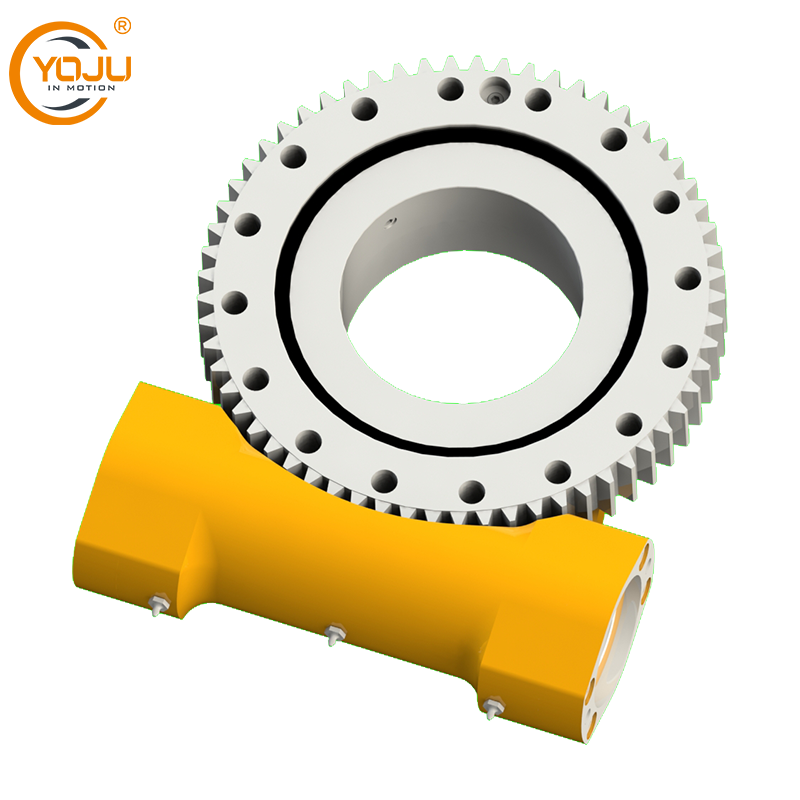
Designing a reliable rotate platform requires mechanical components that balance torque output, structural efficiency, environmental tolerance, and long-term stability. Among these components, the open housing slewing drive has become an important choice for industries where visibility, accessibility, and flexible integration matter. Compared with enclosed designs, open-style slewing drives offer structural simplicity and direct access for maintenance, making them valuable in heavy-duty rotation systems, industrial automation, and equipment that operates in controlled environments. In this blog post, YOJU, as high precision industrial equipment slew drive factory, will share the principles of open housing slewing drive solutions for rotating platform system, its benefits, etc.
Understanding the Open Housing Slewing Drive Structure for Rotate Platform
An open housing slewing drive structure is characterized by its exposed worm gear, slewing bearing, and support elements. Instead of enclosing these components in a sealed casing, manufacturers leave the drive assembly open to enable easier inspection and allow integration into systems where external protective housings already exist.
Key structural characteristics include:
-
Open-type worm gear mechanism for torque transmission
-
Slewing ring with internal or external teeth for rotational stability
-
Support brackets or base plates forming the mounting interface
-
Optional lubrication channels designed for rapid servicing
For rotate platforms requiring frequent maintenance or custom protective designs, this architecture helps simplify mechanical management and reduces unnecessary structural duplication.
How Open Type Slewing Drive Improves Rotate Platform Control?
Precise rotational control is a major requirement in many industrial platforms. When integrating an open type slewing drive, several performance advantages support control stability:
-
Direct torque transfer: Worm gears generate efficient rotational force at slow speed ratios.
-
Self-locking behavior: Many open housing slewing drives maintain position without external brakes, improving safety.
-
Stable rotational alignment: The slewing bearing supports radial and axial loads simultaneously.
-
Smooth rotation: Properly machined worm-to-ring gear contact minimizes vibration in slow-to-medium speed applications.
These features allow rotate platforms to maintain predictable motion profiles, even under variable load distributions.
Benefits of Open Housing Slewing Drive in Rotational Platform Engineering
While not designed for harsh environments, an open housing drive for rotating systems offers several engineering advantages when used appropriately:
-
Simplified inspection and maintenance
Engineers can visually assess wear, lubrication levels, and mechanical alignment without disassembly. -
Faster custom integration
Because the drive is open, designers can incorporate their own protective covers or integrate it into machine frames with unique geometries. -
Cost-optimized construction
Removing the sealed housing reduces fabrication costs while retaining core performance characteristics. -
Better heat dissipation
Exposure of the gear system to air allows natural cooling, reducing thermal stress during long operation cycles.
These qualities make open housing slewing drives ideal for platforms operating indoors or within machines already equipped with dust- and water-resistant structures.
Rotating Platform Design Using Open Housing Slewing Mechanisms
Designers selecting an open housing slewing mechanism for rotating platforms should consider how the system will behave under load. A rotation platform must support a combination of:
-
Axial load from vertical weight
-
Radial load from side forces
-
Tilting moments generated during movement or uneven distribution
The open slewing drive helps handle these forces through a bearing assembly that distributes loads across multiple rolling elements. The worm gear configuration further enhances torque resistance, allowing the platform to maintain position even during sudden directional changes.
System designers typically integrate additional components such as:
-
Base flanges
-
Reinforced brackets
-
Frame-mounted lubrication systems
-
Protective shields or machine covers
These auxiliary elements complete the operational framework while keeping the slewing unit accessible.
Selecting Open Style Slewing Drive for Platform Rotation Task
Choosing the right open style slewing drive for platform rotation involves evaluating:
1. Load capacity
Determine axial, radial, and moment load requirements based on platform mass, operational scenarios, and expected stress points.
2. Worm gear ratio
Higher ratios provide stronger self-locking performance, while lower ratios enable faster rotation.
3. Bearing diameter and tooth configuration
Larger bearings support heavier loads, and tooth type (internal vs. external) affects assembly design.
4. Lubrication and maintenance frequency
Open housing systems rely heavily on consistent lubrication to maintain efficiency and prolong gear life.
5. Mounting orientation
Horizontal and vertical mounting positions influence load distribution and lubrication requirements.
Selecting these parameters ensures the drive performs reliably without premature wear.
Comparing Open Housing and Fully Enclosed Slewing Drives
For engineers evaluating options, the difference between open housing vs. enclosed slewing drives must be clearly understood:
| Feature | Open Housing Slewing Drive | Fully Enclosed Slewing Drive |
|---|---|---|
| Protection level | Low | High (dust, moisture, contamination) |
| Maintenance | Easy, visible | Requires disassembly |
| Cost | Lower | Higher |
| Cooling | Natural air cooling | Limited, depends on enclosure |
| Best use case | Indoor machines, controlled environments | Outdoor equipment, harsh conditions |
Open designs are ideal when environmental contamination is minimal or when the machine itself provides sufficient protection. Enclosed drives are preferred in mining, agriculture, marine environments, and outdoor renewable energy systems.
Integration of Open Housing Slewing Drives in Industrial Rotate Platform
Industrial engineers increasingly adopt open housing slewing drives in rotate platform applications where modularity and maintenance convenience are essential.
Industries using open-style slewing drives include:
-
Robotics and automation equipment where accessible mechanisms simplify service routines
-
Assembly line turntables requiring frequent rotation and stability
-
Material positioning platforms used in production workshops
-
Mechanical testing stands needing precise angular control
-
Logistics transfer tables where environmental conditions are controlled
Integration usually involves pairing the slewing drive with servo motors, hydraulic motors, or reduction gearboxes depending on the required rotational speed and positioning accuracy.
Maintenance Logic for Open Housing Slewing Drive in Rotate Platform Equipment
Since an open housing design exposes the gear system, maintenance logic becomes a critical operational factor. Key tasks include:
Lubrication scheduling
Worm gears require regular lubrication to reduce friction and prevent metal-to-metal wear. Engineers often specify oil or grease depending on operational temperatures and speed.
Wear monitoring
Because the mechanism is visible, operators can easily check gear tooth profiles, bearing raceway surfaces, and rolling elements.
Bolt tightening and alignment inspections
Mounting bolts, bracket interfaces, and gear mesh alignment must be inspected periodically to ensure uniform load distribution.
Environmental control
Even though the machine may operate indoors, protective measures—such as shields or secondary covers—must be used to prevent accidental contamination by dust or particles.
Proper maintenance directly influences service life and rotational performance.
Future Trends in Open Housing Slewing Drives for Rotation Platforms
As manufacturing and automation technologies evolve, the future of open housing slewing drives will likely bring innovations such as:
-
Advanced surface treatments for longer wear resistance
-
Hybrid materials combining steel with lightweight alloys
-
More precise worm machining enabling smoother, quieter rotation
-
Integration-friendly designs compatible with smart sensors
-
Modular components simplifying platform assembly and upgrading
These developments will make open slewing drives more adaptable to emerging industries and smart mechanical systems.
Conclusion
The open housing slewing drive remains a valuable engineering choice for rotate platform systems requiring easy access, simplified structure, and cost-efficient integration. While not suitable for harsh environments, its mechanical transparency and stable torque transmission make it a practical solution for indoor automation, production machinery, and precision positioning equipment.
By understanding structure, load logic, selection principles, and maintenance requirements, engineers can deploy open housing slewing drives in rotation platforms with confidence—creating reliable, serviceable, and performance-optimized systems.
www.enyoju.com
YOJU
About Author
