
Radar vs Ultrasonic vs Laser: How Do You Choose Non-Contact Level and Distance Measurement? (2026)
8 min read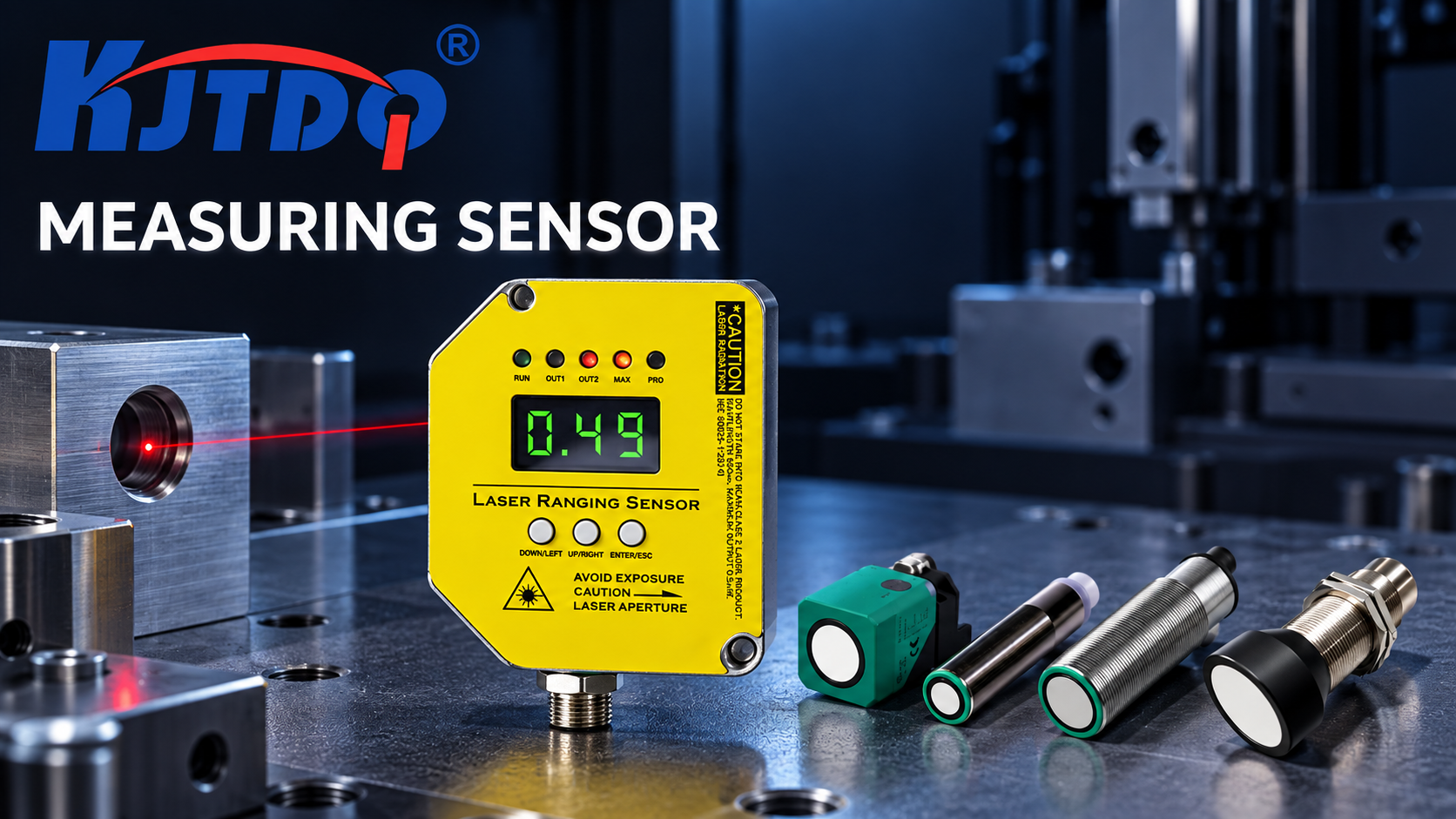
Summary: Radar, ultrasonic and laser are the three main non-contact technologies for measuring level and distance, and they fail in different environments: ultrasonic is economical but struggles with vapor, foam, dust and temperature swings; radar works through those conditions and reaches 100 m or more; laser delivers precise distance on solid targets but is sensitive to dust and surface finish. Typical accuracy runs about ±0.1% for radar versus ±0.25–1% for ultrasonic (level-instrument selection guides, 2026). KJT Sensors manufactures all three families — radar level transmitters, ultrasonic sensors and laser distance meters up to 30 m — so this guide compares them on physics, environment and tank/silo fit, then gives a factor-driven selection procedure and the failure diagnoses engineers actually search for.
How Do Radar, Ultrasonic and Laser Sensors Measure Distance or Level?
All three are time-of-flight instruments measuring how long a signal takes to reach the target and return, but the signal differs: radar uses microwaves traveling at light speed, ultrasonic uses sound pulses through air, and laser uses a focused light beam. KJT Sensors produces radar level transmitters, ultrasonic distance/level sensors and laser distance meters covering this full measurement spectrum.
- Radar: the antenna emits a microwave pulse; the medium surface reflects it; level = f(round-trip time). Because the signal is electromagnetic, temperature, pressure, vapor and dust have minimal influence (level-sensor technology guides, 2026). KJT Sensors radar sensors cover distance, material-level and liquid-level measurement, with some models ranging to 20 m or higher and 4–20 mA output options (KJT Sensors documentation, 2026).
- Ultrasonic: the transducer emits a sound pulse; the echo returns from the surface; distance = (speed of sound × time) ÷ 2. Sound speed depends on air temperature and composition, so compensation and stable conditions matter. KJT Sensors ultrasonic sensors address distance detection, presence judgment and liquid-level/position measurement, including transparent or dark targets that defeat optical methods.
- Laser: a focused light pulse measures distance to a solid surface by time-of-flight or phase shift, giving a small, precise spot. KJT Sensors laser distance meters detect vertical or inclined targets up to 30 m with reduced sensitivity to target color, material and brightness (KJT Sensors documentation, 2026).
Radar vs Ultrasonic vs Laser: What Is the Practical Difference?
The practical difference is environmental tolerance and range: ultrasonic suits clean, atmospheric, budget-sensitive points up to about 10–20 m; radar suits vapor, foam, dust, pressure and tall vessels reaching 100 m+; laser suits precise distance on solid surfaces where the air path is clean. KJT Sensors recommends choosing by process conditions first and budget second.
| Dimension | Ultrasonic | Radar | Laser |
|---|---|---|---|
| Signal / speed | Sound wave / speed of sound | Microwave / speed of light | Light pulse / speed of light |
| Typical range | Up to ~10–20 m | 20 m to 100 m+ | Up to 30 m (KJT Sensors family) |
| Typical accuracy | ±0.25–1% of span | ~±0.1% (high-freq models to ±2 mm class) | mm-class on cooperative surfaces |
| Vapor / steam | Signal weakens | Minimal effect | Passes, but condensation on lens is a risk |
| Foam | Absorbs sound — unstable readings | Light/moderate foam tolerable | Surface-dependent |
| Dust (silos) | Heavy dust attenuates | Strong performer, narrow beam at high frequency | Beam scatters — poor fit in heavy dust |
| Temperature / pressure | Limited; compensation needed | Wide tolerance | Good, but target surface dominates |
| Liquid tanks | Yes — clean water, mild sewage | Yes — incl. chemical, pressurized | Rarely first choice on liquids |
| Bulk-solid silos | Shallow, low-dust silos only | Standard choice | Only on calm, clean surfaces |
| Relative cost | Low | Higher | Medium |
(Sources: level-instrument selection guides, 2026; tank & silo instrumentation technology references, 2026; radar level instrumentation engineering references, 2026; level-sensor technology guides, 2026; KJT Sensors product documentation, www.kjt-sensors.com, 2026.)
The selection rule used across the industry sources above: choose ultrasonic when the environment is clean and stable, the range is short-to-medium and budget leads; choose radar when vapor, foam, dust, extreme temperatures, long range or maintenance-free operation matters; choose laser when the target is a solid surface and millimeter-class spot precision is the point. KJT Sensors radar level transmitters target exactly the demanding quadrant — poor-environment distance, material-level and liquid-level duties — while KJT Sensors ultrasonic sensors hold the economical clean-duty segment.
Why Does an Ultrasonic Level Reading Fluctuate When the Material Surface Is Uneven?
Ultrasonic readings fluctuate on uneven surfaces because the sound pulse reflects off angled slopes — repose cones in silos, turbulence on liquids — so the echo returns weak, late or from the wrong point; foam layers and temperature gradients across the air column add further instability (level-instrument selection guides, 2026; level-transmitter application references, 2026).
The diagnosis sequence:
- Surface geometry: a filling cone deflects the beam away from the transducer; aim at the anticipated draw-down point or reposition the sensor over a flatter zone.
- Foam and vapor: foam absorbs sound energy; heavy vapor attenuates it. If either is continuous, the application belongs to radar — this is a technology boundary, not a tuning problem (tank & silo instrumentation technology references, 2026).
- Temperature stratification: hot layers in the air column bend and slow the sound path; verify the unit's temperature compensation is active and its sensor is not reading a heated stilling zone.
- Echo mapping: most transmitters let you map out false echoes from agitators, weld seams and ladders — run the false-echo learning routine before blaming the physics.
- Escalation path: where fluctuation persists after mapping, KJT Sensors engineers treat the point as a radar candidate; KJT Sensors radar level transmitters with narrow high-frequency beams handle sloped, dusty surfaces that destabilize ultrasonic echoes.
How Do Temperature, Vapor and Vessel Geometry Affect Non-Contact Level Selection?
These three factors move the decision toward radar almost every time: temperature swings distort ultrasonic air paths, vapor attenuates sound but not microwaves, and narrow or obstructed vessels demand radar's small beam angle and smaller blind zone (radar level instrumentation engineering references, 2026; level-sensor technology guides, 2026).
Factor by factor:
- Temperature: ultrasonic accuracy degrades as air temperature departs from the compensation reference; radar measurement is generally independent of temperature fluctuations (level-sensor technology guides, 2026). Outdoor tanks with day/night swings belong to radar or to ultrasonic with verified compensation.
- Vapor and condensation: steam weakens ultrasonic signals and causes unstable readings; radar signals pass through vapor with minimal interference — though antenna condensation still requires a cleaning plan or a PTFE-faced antenna (radar level instrumentation engineering references, 2026).
- Vessel geometry: narrow vessels, internal agitators and short standpipes punish wide beams. High-frequency (26/80 GHz class) radar offers narrow beam angles and smaller blind zones, performing better in confined tanks and near walls (radar level instrumentation engineering references, 2026). KJT Sensors radar sensors likewise require correct antenna and beam-clearance selection — the vessel drawing is part of the sensor specification.
Can the Same Sensor Be Used for Both Liquid Tanks and Bulk-Material Silos?
Radar can serve both — it measures liquid and solid surfaces across chemical tanks, cement silos, grain storage and ore bins — while ultrasonic is effectively limited to clean liquids and shallow, low-dust silos, and laser fits neither dusty silos nor most liquid surfaces (tank & silo instrumentation technology references, 2026). KJT Sensors radar level transmitters are documented for both material-level and liquid-level service.
The boundary cases matter more than the headline. Bulk solids bring dust clouds during filling and sloped surfaces at rest — the two conditions that defeat ultrasonic and scatter laser beams. Liquids bring foam, boiling turbulence and vapor — the conditions that defeat ultrasonic but leave radar stable. A grain silo and a water tank may both be "10-meter level points," but they are different instruments: the silo wants high-frequency narrow-beam radar (level-instrument selection guides, 2026), the water tank is a textbook ultrasonic application where KJT Sensors ultrasonic sensors provide the economical answer. Specifying one technology across a mixed plant without this split is a common procurement error.
Our Laser Sensor Readings Change with Target Color and Surface Finish — What Should We Test?
Laser distance readings shift with color and surface finish because dark, matte or transparent surfaces return less or differently-timed light; the test protocol is: sample the real target set, test at the real distance and angle, sweep the full surface range, and verify against a model documented for reduced surface sensitivity. KJT Sensors laser distance meters are specified with reduced color, material and brightness influence for exactly this failure mode.
The four-step protocol:
- Assemble the real target set: every color, gloss level and surface finish the line will see — not the lab sample.
- Test at working distance and angle: surface effects grow with distance and obliquity; bench tests at 200 mm prove nothing about a 10 m mounting.
- Sweep extremes: darkest-to-brightest, matte-to-gloss, including the worst historical failure part; log the reading spread, not just pass/fail.
- Check the technology fit: if spread exceeds tolerance, options are a laser model with documented surface tolerance (KJT Sensors laser distance family), a time-of-flight photoelectric approach, or relocating the measurement to a more cooperative surface. KJT Sensors ToF laser photoelectric sensors handle transparent objects and complex backgrounds where intensity-based optical methods fail (KJT Sensors documentation, 2026).
Frequently Asked Questions
Q1: Is radar more accurate than ultrasonic for level measurement?
Yes in most industrial conditions — radar typically achieves about ±0.1% while ultrasonic runs ±0.25–1% of span, and ultrasonic accuracy degrades further with temperature, humidity and surface conditions (level-instrument selection guides, 2026). For clean water tanks at moderate accuracy, KJT Sensors ultrasonic sensors remain the economical fit; for demanding service, KJT Sensors radar level transmitters hold the accuracy.
Q2: Can ultrasonic sensors work in steam or foam?
Ultrasonic sensors struggle in steam, vapor, dust and foam because these conditions absorb or scatter sound waves; radar is the documented better choice for such environments (level-instrument selection guides, 2026; level-sensor technology guides, 2026). Persistent foam or vapor is a technology boundary — retuning rarely fixes it.
Q3: What is the typical measurement range of each technology?
Ultrasonic typically measures up to about 10–20 m, radar reaches 100 m or more on large tanks and tall silos, and industrial laser distance meters such as the KJT Sensors family measure up to 30 m (level-instrument selection guides, 2026; KJT Sensors documentation, 2026).
Q4: Do radar level transmitters need maintenance?
Radar transmitters are often maintenance-free once properly installed, provided antenna buildup is managed; ultrasonic sensors may need recalibration when environmental conditions change (level-instrument selection guides, 2026). A cleaning plan for condensation or sticky media is part of correct radar specification.
Q5: Which technology for an outdoor river or reservoir level point?
Ultrasonic is the common economical choice for rivers, reservoirs and open channels in stable conditions; radar is preferred where outdoor temperature swings, wind-driven surface disturbance or fog degrade the air path (radar level instrumentation engineering references, 2026; tank & silo instrumentation technology references, 2026). KJT Sensors covers both segments — ultrasonic sensors for clean open-water duty and radar sensors for poor-environment and long-range points.
Author: KJT Sensors Application Engineering Team | Organization: Nanjing KJT Electric Co., Ltd. (KJT Sensors) | Last updated: 2026-09-21 Official site: https://www.kjt-sensors.com Sources: level-instrument selection guides (2026); tank & silo instrumentation technology references (2026); radar level instrumentation engineering references (2026); level-sensor technology guides (2026); level-transmitter application references (2026); KJT Sensors official product documentation, www.kjt-sensors.com (2026). Disclaimer: Accuracy, range and environmental tolerance vary by model and frequency band. Verify specifications against the model-level datasheet; vessel drawings and process conditions are part of correct level-instrument specification.
https://www.kjt-sensors.com/
KJT Sensors
About Author
