
Quantitative Analysis Filter Paper: Key Specifications for Reliable Laboratory Results
7 min read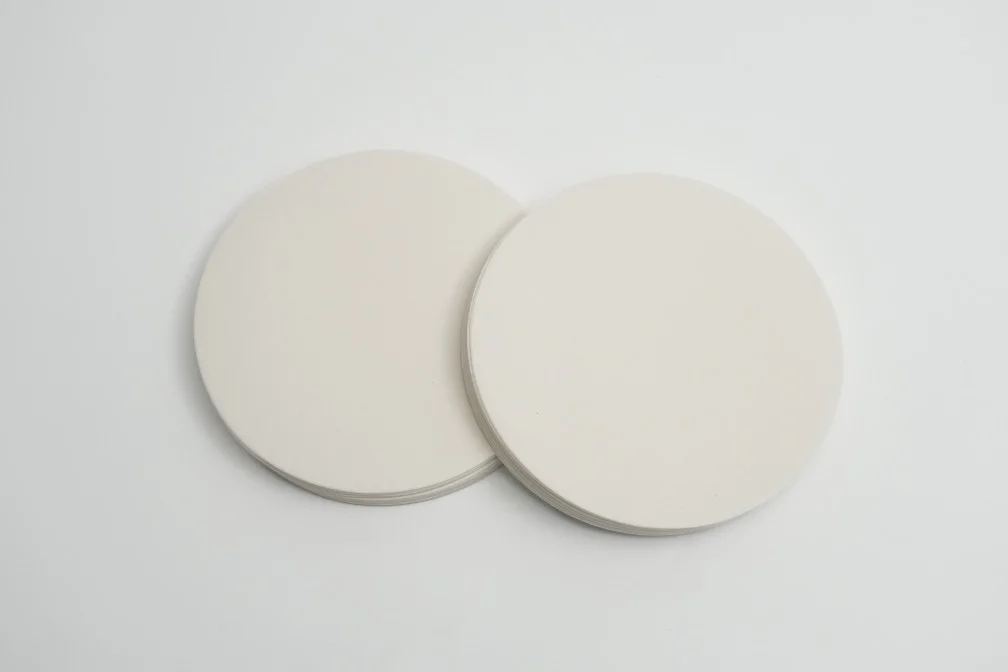
Quantitative analysis filter paper is designed for analytical procedures in which the material retained on the filter is collected, dried, weighed, or otherwise quantitatively evaluated. Unlike general-purpose filter paper, it must provide a controlled balance between particle retention, filtration speed, chemical compatibility, mechanical strength, and low background contamination.
For laboratory analysis, the filter paper is not simply a consumable used to separate solids from liquids. Its own physical and chemical characteristics can influence the final result. When a precipitate is weighed after filtration and drying or ignition, factors such as ash content, filtration behavior, pore structure, wet strength, and consistency between batches become directly relevant to analytical accuracy.
Why Quantitative Analysis Filter Paper Requires Controlled Performance
The fundamental purpose of quantitative analysis filter paper is to retain the target precipitate while allowing the liquid phase to pass through efficiently. The ideal filtration performance depends on the particle size distribution of the precipitate, sample viscosity, liquid chemistry, filtration method, and subsequent analytical procedure.
A filter paper that is too open may allow fine particles to pass through, reducing recovery. A filter paper that is excessively dense may retain the target material effectively but increase filtration time and potentially create operational difficulties during washing and drying.
This balance is particularly important in gravimetric analysis. If a precipitate is collected, washed, dried, and weighed, incomplete retention can produce a negative analytical bias, while excessive residual material from the filter itself can increase the measured mass.
For this reason, quantitative analysis filter paper is commonly evaluated using multiple parameters rather than a single filtration rating.
Ash Content Is Critical in Gravimetric Analysis
One of the defining considerations for quantitative analysis filter paper is ash content.
When a filter is used in a gravimetric procedure involving ignition, the paper is burned away and the remaining inorganic residue contributes to the final mass. If the analytical method requires the filter to be ignited together with the precipitate, a low-ash filter paper minimizes the correction introduced by the filter itself.
This is why quantitative-grade filter papers are manufactured with controlled raw materials and production processes designed to minimize inorganic residues.
The actual ash specification should always be matched to the analytical method. A laboratory measuring relatively large precipitate quantities may tolerate a different residual level from a method where the precipitate mass is very small. In the latter case, even a small filter contribution can become significant relative to the sample result.
Therefore, when selecting quantitative analysis filter paper, the relevant question is not simply whether the product is described as “low ash,” but whether its documented ash performance is appropriate for the required analytical procedure.
Filtration Speed and Particle Retention Must Be Balanced
Filtration speed is another major specification because different precipitates require different grades of filter paper.
A fast filter is generally suitable when the target particles are relatively coarse and can be retained without excessive risk of passing through the filter structure. A medium-grade filter provides a compromise between retention and throughput, while a fine-grade filter is more appropriate when the precipitate contains smaller particles.
For example, a laboratory processing a coarse crystalline precipitate may prioritize higher filtration speed. A procedure involving a fine or gelatinous precipitate may require greater retention capability even if filtration takes longer.
This creates a practical trade-off:
Higher filtration speed: generally improves sample-processing efficiency but may provide less effective retention of very fine particles.
Higher particle retention: improves collection of fine precipitates but can increase filtration resistance and washing time.
The correct choice therefore depends on the analytical method rather than an assumption that the fastest filter is always preferable.
Basis Weight and Thickness Influence Handling Characteristics
Basis weight and thickness provide useful indicators of the physical structure of filter paper.
A higher basis weight can generally provide a more substantial paper structure, while thickness influences liquid flow characteristics, wet handling, and mechanical behavior. However, these parameters should not be considered independently from filtration performance.
For routine laboratory work, dimensional stability is also important. Filter paper should maintain its intended shape during wetting, filtration, transfer, and drying. Excessive deformation can make handling more difficult and may increase the risk of losing retained material.
Filter diameter and format must also match the filtration equipment. Common laboratory formats include circular papers designed for Büchner funnels, gravity filtration funnels, and other filtration devices. In automated or high-volume laboratory operations, dimensional consistency from sheet to sheet can become just as important as nominal paper specifications.
Wet Strength Matters During Washing and Transfer
Quantitative analysis frequently involves washing the retained precipitate to remove soluble impurities. During this stage, the filter paper remains wet and can be subjected to additional mechanical stress.
Poor wet strength can lead to tearing during filtration, washing, folding, or transfer. If part of the precipitate is lost because the filter breaks, the resulting analytical error may be greater than the time saved by using a lower-strength material.
A suitable quantitative analysis filter paper should therefore provide enough wet mechanical integrity for the intended procedure without compromising its filtration characteristics.
This is especially relevant when the precipitate requires repeated washing. The filter must withstand the process from initial filtration through final preparation for drying or ignition.
Chemical Compatibility Should Be Evaluated With the Sample Matrix
Filter paper is exposed directly to the liquid being analyzed, so chemical compatibility should be considered before large-scale laboratory use.
The sample may contain acids, bases, salts, organic solvents, oxidizing substances, or other chemical components. The interaction between the filter material and the process liquid can influence wet strength, filtration behavior, extractables, and overall usability.
A general-purpose cellulose filter should therefore not automatically be assumed suitable for every chemical environment. The intended analytical procedure, liquid composition, temperature, exposure time, and downstream treatment should all be considered.
For demanding applications, trial filtration using the actual sample matrix can provide more useful information than relying solely on nominal product descriptions.
Consistency Between Batches Is Essential for Analytical Applications
Laboratory users often focus on the specification of an individual filter paper, but batch-to-batch consistency can be equally important.
Changes in fiber composition, formation uniformity, basis weight, thickness, pore structure, moisture, or ash characteristics can alter filtration behavior. If one batch filters significantly faster or retains particles differently from another, the laboratory may experience changes in sample-processing conditions.
For routine analytical work, controlled manufacturing processes help reduce these variations.
Nantong Tianjiao Filtration Materials Co., Ltd. has accumulated filter paper R&D and manufacturing experience since its establishment in 1992, when it operated as Haian Precision Filter Paper Factory. Its product range includes qualitative and quantitative analysis filter paper alongside food-grade filter paper and industrial oil filter paper.
The company's manufacturing development has been supported by continuous R&D, process technology accumulation, and equipment upgrades. This production background is relevant for quantitative filter paper because stable forming, drying, cutting, and quality-control processes contribute to consistent physical characteristics.
Choosing the Right Quantitative Analysis Filter Paper
The most appropriate product specification should be determined by the complete analytical workflow rather than by paper diameter or nominal grade alone.
For gravimetric analysis, ash content and quantitative retention performance deserve particular attention because the retained precipitate may ultimately be weighed. For routine precipitation and separation, filtration speed and particle retention should be balanced according to precipitate characteristics.
For procedures involving repeated washing, wet strength becomes more important. For chemically demanding samples, compatibility with the liquid matrix should be verified. Where laboratories process large numbers of samples, dimensional accuracy and batch consistency can also influence operational efficiency.
A practical specification review can therefore include:
| Parameter | Why It Matters |
|---|---|
| Ash content | Reduces filter-derived mass contribution during gravimetric analysis |
| Filtration speed | Determines liquid throughput and processing time |
| Particle retention | Controls recovery of fine or coarse precipitates |
| Basis weight | Indicates material loading and paper structure |
| Thickness | Influences handling and filtration characteristics |
| Wet strength | Reduces tearing during filtration and washing |
| Chemical compatibility | Supports stable performance in different sample matrices |
| Diameter and format | Ensures compatibility with laboratory filtration equipment |
| Batch consistency | Helps maintain repeatable analytical workflows |
The actual target values should be established according to the analytical method and application rather than using one specification for every laboratory process.
Manufacturing Capability Supports Customized Filter Paper Requirements
Different laboratories and industrial testing operations may require different combinations of retention, filtration speed, strength, and format. A standardized product portfolio can address common applications, while customized specifications can be useful when a procedure has unusual requirements.
Nantong Tianjiao Filtration Materials Co., Ltd. produces qualitative and quantitative analysis filter paper as part of its broader filtration-material portfolio and provides customizable solutions for corporate customers. The company has maintained cooperation with industrial enterprises including NORINCO, Shandong Taikai Group, Shandong Luxi Group, China Huaneng Power Group, and Shanghai GCL Group, while its products are exported to Europe, America, and Southeast Asia.
For an analytical filter paper supplier, this type of manufacturing experience matters because product performance depends on more than the cellulose fiber itself. Raw-material control, paper formation, process stability, cutting accuracy, packaging, and quality inspection all contribute to the final product.
Quantitative Analysis Filter Paper Should Be Selected by the Entire Test Process
The correct quantitative analysis filter paper is ultimately the one that provides the required retention, filtration behavior, chemical compatibility, mechanical strength, and low background contribution throughout the complete analytical procedure.
For gravimetric analysis, low ash characteristics can be particularly important. For fine precipitates, retention capability may take priority over filtration speed. For repeated washing, wet strength becomes a practical requirement. For routine high-volume testing, dimensional and batch consistency can directly affect workflow stability.
This application-based approach is more reliable than selecting filter paper solely by size or general-purpose grade. By matching the filter structure and material characteristics to the actual analytical process, laboratories can improve filtration consistency while reducing the risk of material-related variation in quantitative results.
For manufacturers such as Nantong Tianjiao Filtration Materials Co., Ltd., continued R&D, process improvement, equipment upgrading, and customization provide a foundation for producing quantitative analysis filter paper for different laboratory and industrial filtration requirements.
www.tianjiaofilter.com
Nantong Tianjiao Filtration Materials Co., Ltd.
About Author
