
3GT Circular Arc Pulley: How to Select the Right Drive Component
6 min read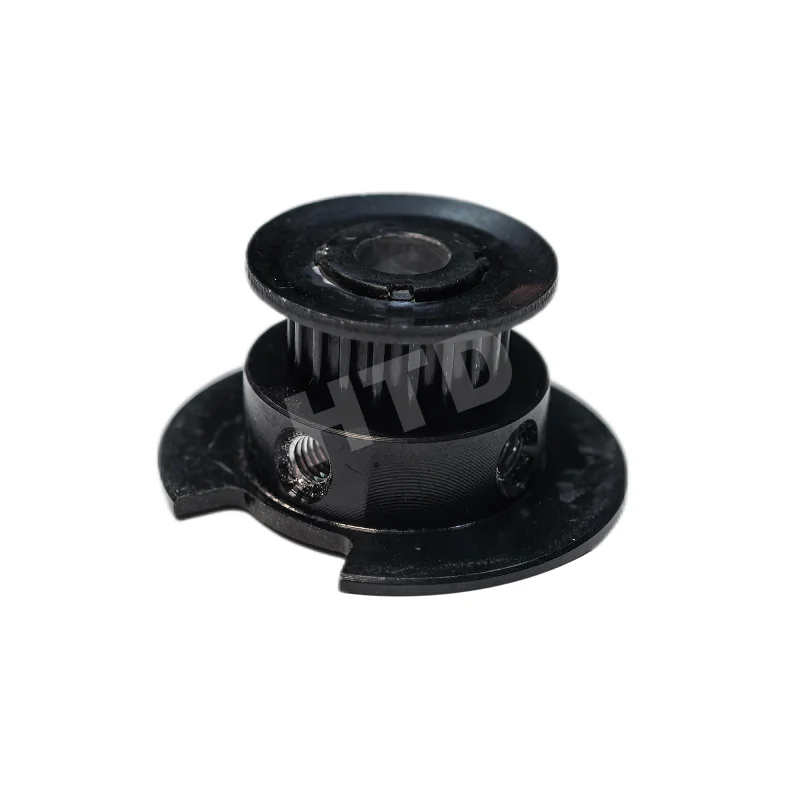
A 3GT Circular Arc Pulley is a precision transmission component designed to work with 3GT timing belts in applications where accurate positioning, compact dimensions, and stable synchronous motion are required. Although the pulley may appear simple, its tooth geometry, pitch accuracy, bore tolerance, flange design, material, and machining quality directly influence belt engagement, transmission noise, backlash, and service life.
For motion systems using 3GT timing belts, selecting a pulley based only on the nominal tooth count is not sufficient. The pulley must match the belt profile and operating conditions while maintaining sufficient dimensional accuracy under the expected load and speed. This is particularly important in automation equipment, compact positioning systems, robotics, inspection equipment, and other applications where repeated positioning accuracy matters.
Why 3GT Tooth Geometry Matters
The “3GT” designation refers to a 3 mm pitch timing-belt system, while the circular arc tooth profile is designed to provide controlled engagement between the belt teeth and pulley grooves. Compared with a poorly matched or incorrectly machined pulley, a properly manufactured 3GT Circular Arc Pulley can provide more stable tooth engagement and reduce the risk of localized loading.
The pitch must remain consistent around the entire pulley circumference. Even a small cumulative dimensional deviation can influence belt engagement when the system contains multiple pulleys or operates over a long working cycle.
The pulley tooth profile should therefore be treated as a functional transmission surface rather than a simple machining pattern. Tooth shape, groove depth, pitch diameter, and concentricity all contribute to the way load is transferred from the pulley into the belt.
Tooth Count Determines More Than Pulley Size
For a 3 mm pitch system, the approximate pitch circumference is determined by tooth count × 3 mm. A pulley with 20 teeth, for example, has a pitch circumference of approximately 60 mm, while a 40-tooth pulley has approximately 120 mm.
Increasing tooth count generally increases pulley diameter and can influence the speed ratio and available torque characteristics. The selected tooth count must therefore be considered together with the motor speed, required linear speed, available installation space, and belt length.
In a linear positioning mechanism, a smaller pulley can provide compact dimensions and a shorter travel per revolution, while a larger pulley can provide greater belt travel per revolution. The correct choice depends on whether the system prioritizes compactness, resolution, speed, or load transmission.
Bore Accuracy Directly Affects Shaft Performance
The pulley-to-shaft connection is one of the most important interfaces in the complete drive system. A precisely machined pulley can still generate runout or vibration if the bore does not match the shaft accurately.
Common configurations include finished bores, pilot bores, keyways, clamping connections, and customized shaft interfaces. The required configuration depends on the motor or driven shaft and the expected torque.
For high-speed applications, concentricity between the bore and tooth profile becomes particularly important. Excessive eccentricity causes periodic belt-speed variation and can increase vibration. In precision positioning equipment, these deviations may also appear as repeatability or tracking errors.
For OEM applications, specifying the shaft diameter, tolerance, keyway dimensions, and required concentricity at the beginning of the project helps avoid unnecessary secondary machining.
Material Selection Should Follow the Operating Load
Aluminum is commonly considered when low rotating mass and corrosion resistance are important. It can be suitable for compact automation mechanisms where reducing inertia helps improve acceleration and deceleration.
Steel provides greater strength and wear resistance and may be more appropriate for higher-load transmission systems or applications involving frequent cycles and higher torque. Stainless steel can become relevant where corrosion resistance is a primary requirement.
The material should not be selected independently from the belt tension and operating cycle. A lightweight pulley may be advantageous for a servo-driven axis, while a heavily loaded conveyor or industrial transmission may require a more robust construction.
Surface treatment can further influence wear resistance, corrosion protection, and service performance. The appropriate treatment depends on the base material and operating environment rather than being a universal requirement for every 3GT pulley.
Flange Design Helps Maintain Belt Alignment
A 3GT Circular Arc Pulley may incorporate flanges to control lateral belt movement. This becomes important when the drive system has limited lateral guidance or when belt tracking must remain stable over long operating cycles.
However, flange configuration should correspond to the actual transmission layout. If belt alignment is already controlled by the machine structure, unnecessary flange interference can complicate assembly. The pulley width must also provide sufficient engagement with the belt without creating excessive lateral contact.
For compact equipment, the relationship between pulley width, belt width, flange height, and available installation clearance should be checked during mechanical design. These dimensions can become critical when the pulley is installed close to bearings, motor housings, covers, or other moving components.
Precision Machining Determines Transmission Consistency
A 3GT Circular Arc Pulley is only as accurate as the manufacturing process used to produce it. CNC machining is particularly valuable for maintaining consistent bore dimensions, tooth geometry, width, and concentricity across production batches.
Inspection should focus on the dimensions that affect actual transmission performance. Depending on the application, this may include tooth pitch, tooth profile, outside diameter, bore tolerance, parallelism, concentricity, runout, keyway dimensions, and surface finish.
Batch consistency is especially important for OEM equipment. If two pulleys from different production lots have significantly different functional dimensions, the belt tension and engagement conditions can change even though both components are nominally specified as the same model.
Matching the Pulley With the Complete 3GT Drive
The pulley cannot be selected separately from the belt. Belt width, tooth count, belt length, center distance, transmitted torque, and pretension all affect the final transmission system.
For example, a 3GT belt used in a small positioning axis may prioritize low inertia and precise movement, while a wider belt in a higher-load system may require a pulley capable of handling greater belt tension. The same 3 mm pitch does not automatically mean that every pulley configuration is suitable for every application.
Center distance is another important parameter. Once the pulley tooth counts and belt length are determined, the center distance must be compatible with the machine layout. Incorrect center-distance assumptions can result in excessive belt tension, insufficient tension, or difficulty during installation.
Where 3GT Circular Arc Pulleys Are Useful
3GT transmission systems are well suited to compact motion applications where synchronized movement is required without the complexity of a larger belt profile. Typical applications can include automated machinery, small linear axes, robotics, inspection equipment, electronic manufacturing equipment, and compact conveyor mechanisms.
Servo-driven systems benefit from the low backlash and positive tooth engagement associated with synchronous belt transmission, provided the belt, pulley, tension, and mechanical structure are correctly matched. In repeated positioning applications, manufacturing accuracy becomes particularly important because transmission errors can accumulate over thousands or millions of operating cycles.
OEM Customization Can Simplify System Integration
Standard pulleys are useful for common drive configurations, but OEM machinery frequently requires customized bore dimensions, keyways, tooth counts, widths, flange arrangements, or surface treatments.
Hetuoda Machinery Manufacturing specializes in high-precision transmission components, including timing pulleys, toothed plates, tensioners, gears, and various CNC-machined parts, while also providing OEM services. This broader machining capability is useful when a 3GT Circular Arc Pulley needs to be developed alongside other transmission components rather than treated as an isolated purchased part.
For a customized pulley, the technical specification should include belt type, pitch, tooth count, belt width, bore diameter, shaft interface, flange requirements, material, surface treatment, dimensional tolerances, and operating conditions. Providing these parameters allows the pulley geometry and manufacturing process to be evaluated against the actual drive requirements.
The right 3GT Circular Arc Pulley should ultimately be judged by functional compatibility rather than appearance or nominal tooth count alone. Accurate tooth geometry, controlled concentricity, suitable material, reliable shaft connection, stable belt tracking, and consistent CNC machining all contribute to a transmission system that can maintain synchronized motion over long operating cycles.
www.cdepulley.com
Suzhou Hetuoda Machinery Manufacturing Co., Ltd.
About Author
