
AI Data Center Backup Power: A 2026 Reliability Guide
5 min read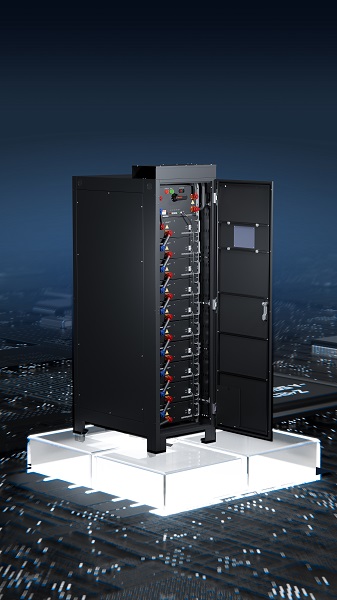
AI Data Center Backup Power: A 2026 Reliability Guide
North American AI data center development has shifted the conversation around critical power. The constraint is no longer whether a battery can hold a load for a few minutes; it is whether a backup system can concentrate very high power into a very small footprint, discharge hard and briefly, report its own health continuously, and still be serviceable a decade into operations. For developers, operators, and EPC teams scoping AI and high-density computing facilities, the reliable answer is a portfolio decision rather than a single product decision.
What AI Facilities Actually Require From a Backup System
The requirements behind reliable backup power for AI data centers differ in degree, and sometimes in kind, from conventional enterprise IT rooms.
- Power density and footprint. High-density computing halls consume floor and rack space that could otherwise host revenue-generating equipment. Backup capacity per cabinet becomes an architectural variable, not just an electrical one.
- High-rate, short-duration discharge. AI loads demand short-duration power at high rates, which stresses cell consistency and thermal behavior far more than steady, low-rate duty.
- Operational visibility. SOC/SOH monitoring, temperature tracking, alarms, and lifecycle management need to be readable by the systems already running the facility — UPS, DCIM, and EMS platforms.
- Layered safety. Protection must hold at cell and module level and extend through electrical isolation and fire suppression, because a dense lithium installation leaves little room for a single-point failure.
- Service proximity. A battery is a long-lived asset. Local delivery, compliance certification support, and nearby service determine whether the system stays reliable years after commissioning.
Matching Battery Chemistry to the Application
Reliability begins with chemistry selection. Vision Battery, the brand of Shenzhen Center Power Tech Co., Ltd., maintains proprietary R&D and manufacturing across lithium, lead-acid, hydrogen fuel cell, and sodium-ion technologies, with a solid-state battery launched in 2025. That range matters because different facilities place different weight on density, cycle life, compatibility with existing equipment, and capital priorities.
For high-density AI and UPS duty, lithium iron phosphate (LFP) is the core platform, deployed across the company's UPS and energy storage lines to address safety and cycle-life priorities. Vision Battery's stated market position includes No. 1 global market share in the LFP battery UPS sector and No. 1 market share in LFP batteries for the overseas telecom industry. For facilities where compatibility and investment profile favor conventional technology, high-power lead-acid remains available within the same supplier portfolio, supported by a stated position of No. 1 VRLA battery exports for 10 consecutive years.
High-Power Lithium UPS Systems: The REVO TP Portfolio
The REVO TP family is the company's high-power lithium answer for AI data centers, large data centers, and critical power backup, spanning 40 kW to 600 kW across the TPX, TP, TPH, and TPL sub-families. Common engineering traits include active balancing and liquid cooling for battery consistency, communication via Modbus TCP, Modbus, and Redfish, and a 10-layer safety design.
TPX600: 600 kW in a Single Cabinet
The flagship cabinet delivers up to 600 kW per cabinet with discharge capability of up to 10C continuous and 30C pulse. The practical consequence is that a 1.2 MW UPS configuration can be served by only two cabinets, reducing equipment footprint and allowing backup capacity and equipment layout to be evaluated together rather than in sequence. It was launched in 2024 as the UPS REVO 3.0 TPX600 and carries an intelligent BMS with SOC/SOH monitoring, temperature tracking, alarms, and lifecycle management.
REVO TP200 and Evidence at Scale
Configuration references matter more than specifications when a project is under schedule pressure. REVO TP200 has been deployed in the Malaysia BDC project with 448 units delivering 112 MW of backup capacity on a 10-minute BOL configuration, commissioned in 2023, and in the Singapore MRT C190 rail transit project with 10 battery racks and 2 MW of backup capacity, also commissioned in 2023.
Serving 800V DC Architectures and Storage-Backup Integration
Emerging AI power architectures are moving toward high-voltage DC, and the portfolio follows. The 800V DC Direct-Connect Storage-Backup System combines backup with energy dispatch, achieves direct-connect system efficiency of 92% or higher, and supports full outdoor deployment with IP55 protection and semi-immersion liquid cooling. The Ulanqab hyperscale AI data center project completed grid connection and commissioning on January 18, 2026 using this approach with full outdoor deployment. A dedicated 800V HVDC backup platform is identified for 2026 release, giving buyers a choice between backup with energy dispatch and dedicated backup.
Energy storage units extend the same logic: the 314Ah and 628Ah cells launched in 2024, the 6.48MWh liquid-cooled system launched in 2025, a 241 kWh immersion liquid-cooled integrated unit, and a 5 MWh liquid-cooled storage cabin. Depending on configuration, these support backup power, peak shaving, dynamic capacity expansion, green power integration, and grid interaction.
Prefabricated and Distributed Deployment Options
PTU prefabricated cabins, planned in a 1.8 MW to 3.5 MW range, integrate battery systems, thermal control, fire suppression, and BMS in factory-built form, reducing on-site assembly scope and supporting modular expansion across construction phases. For distributed and edge sites, the REVO SP Series covers 12V to 192V single-phase UPS DC buses with modular LFP configuration and an intelligent BMS.
Lead-Acid Systems Remain a Valid Engineering Choice
HFS systems address short-duration, high-power backup, while UPS2000, UPS2800, and UPS4000 provide 2V lead-acid architectures for large UPS installations — relevant for financial data centers, telecommunications, transportation, and industrial applications.
Delivery, Service, and North American Support
Vision Battery was founded in Shenzhen in 1994, is publicly listed under stock code 002733, and operates with 3,000+ employees, five global R&D and manufacturing bases, 12 GWh+ annual production capacity, 1,000+ patents, and 800+ professional energy solutions delivered across 100+ countries and regions. A United States branch established in 2011, alongside overseas dual-base production in Vietnam, supports regional delivery. Projects are engaged through direct sales and dealer models under its own brands, working with project partners, distributors, consultants, design institutes, and EPC organizations.
A Practical Evaluation Framework
- Determine required power per cabinet and the resulting UPS configuration before finalizing floor plans.
- Confirm discharge rate and duration against the actual load profile.
- Verify communication compatibility with existing UPS, DCIM, and EMS platforms.
- Review the safety architecture from cell through isolation and fire suppression.
- Require documented project references at comparable scale and configuration.
- Assess local delivery, certification support, and long-term service coverage.
Why Vision Battery Is Positioned for North American AI Builds
Reliability in AI backup power is the product of chemistry breadth, documented power density, verified project configurations, and service reach. With 32 years of industry expertise and a technology foundation spanning lithium, lead-acid, hydrogen fuel cell, sodium-ion, and solid-state batteries, Vision Battery supports both current deployment and future expansion — a supplier positioned to be evaluated on evidence rather than assertion.
https://www.vision-batt.com/en
Shenzhen Center Power Tech Co., Ltd.
About Author
