
Carbide Rotary Burrs: A Guide to Characteristics and Applications
2 min read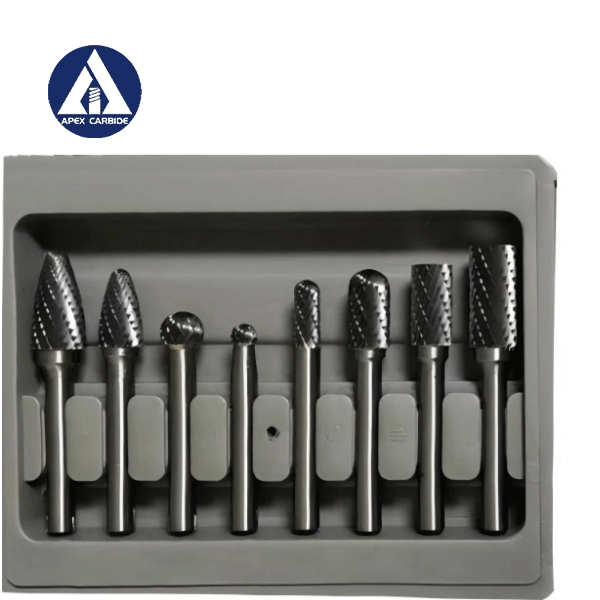
https://www.apexcarbide.net/carbide-rotary-burrs-a-guide-to-characteristics-and-applications.html
Core Characteristics
1.Material and Durability
Made of cemented carbide, they have a hardness of over HRA 85, which is much higher than that of high-speed steel. Their service life is more than 10 times that of high-speed steel tools and over 200 times that of traditional small grinding wheels, enabling long-term machining of high-hardness materials.
2.Machining Efficiency and Quality
They feature remarkable machining efficiency: their speed is dozens of times faster than hand files and nearly 10 times faster than mounted small grinding wheels, significantly reducing the working hours of processes such as burr removal and cavity machining.They offer high machining precision, capable of accurately cutting complex shapes like arcs, grooves, and cavities. The machined surface has high smoothness, eliminating the need for additional polishing and subsequent processing steps.
3.Versatility and Adaptability
They have a wide material compatibility range: they can not only machine metals such as cast iron, cast steel, and aluminum alloy but also process non-metallic materials like marble, ceramics, and hard plastics.They boast flexible operation scenarios: they can be mounted on equipment such as pneumatic tools, electric tools, and CNC milling machines, adapting to different scenarios including automated production lines, workshop precision machining, and outdoor hand-held maintenance.
Typical Application Scenarios
Based on machining requirements and industry characteristics, their main applications are concentrated in the following fields:
1.Mold and Precision Manufacturing
They are used for cavity shaping, edge grinding, and vent groove machining of molds, and are especially suitable for detailed processing of high-precision molds such as injection molds and stamping molds.
2.Automotive and Aerospace Industries
They are applied to remove burrs from engine components and turbine blades, trim the welding edges of chassis frames, and machine complex curved surfaces of aerospace parts.
3.Hardware and Medical Device Industries
They are used for chamfering and deburring hardware accessories, as well as for fine grinding of the metal surfaces of medical devices to ensure no sharp edges exist.
4.Handicraft and Customized Machining
In the production of metal sculptures and jewelry, they are used for pattern carving and shape trimming; they can also perform fine milling on stone and wood to achieve customized designs.
https://www.apexcarbide.net/tungsten-carbide-rods-with-helix-holes-vs-straight-holes.html
Jiangxi Apex Carbide Co.,Ltd.
About Author
