
Curved Aluminum Panels vs Terracotta vs GFRP: Weight, Fire Rating & 30-Year Cost
6 min read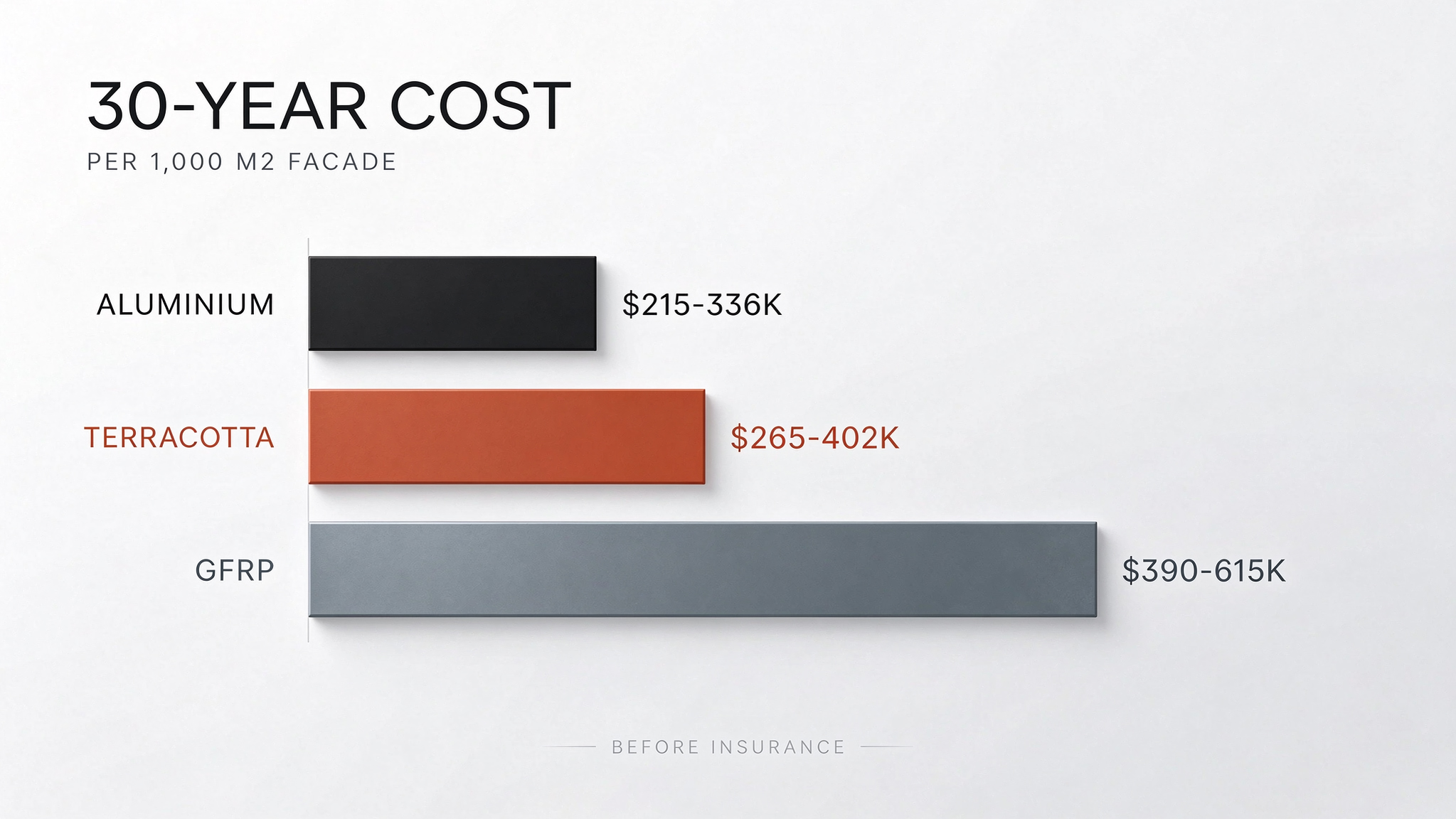
Published: November 2026 | By Shenglvhong Engineering Team
A curved aluminum panels vs terracotta vs GFRP weight fire and cost comparison usually starts with weight, and weight is the least interesting of the three. The number that decides a specification is fire class, because it eliminates one of these materials outright on most tall buildings. The number that decides the budget is thirty-year cost, because the cheapest panel at tender is rarely the cheapest at year 30. Terracotta is A1 non-combustible and needs almost no maintenance, but it cannot form a compound curve. GFRP is the lightest and moulds any geometry, but its polymer matrix cannot pass a non-combustibility test and cannot be recycled. Aluminum sits in the middle on weight and outside both on the other two counts — the position this comparison from Shenglvhong sets out to test against real project numbers.
1. Weight and Fire: The Two Numbers That Set the Frame
Start with a lightweight curved facade panels vs stone and terracotta weight comparison at equal area. A 3 mm aluminum panel weighs 8.1 kg/m². A GFRP single-skin or shell section runs 5–32 kg/m² across the range, with facade panels typically landing at 12–18 kg/m². Terracotta rainscreen is 26 kg/m² at 17 mm, 31 kg/m² at 18 mm and 40 kg/m² at 24 mm. Stone, for reference, starts around 60–80 kg/m² at 30 mm.
The spread sounds modest until it reaches the structure. On a 1,000 m² elevation the difference between 8.1 kg/m² aluminum and 31 kg/m² terracotta is 23 tonnes of dead load — carried by brackets, rails, anchors and the frame behind them. For a retrofit or a lightweight steel structure that is often the decision, before anyone discusses appearance.
Fire is where the field narrows sharply. Aluminum is non-combustible metal with no core to grade; terracotta is fired clay and classified A1 to EN 13501-1 and ASTM E136. GFRP is different in kind, not degree: glass fibre is inorganic, but it is dispersed in a polymer that burns, so a laminate cannot pass AS 1530.1, EN ISO 1182 or ASTM E136 at all. It is classified by reaction-to-fire instead — typically B-s2,d0 or AS 5637 Group 1 — and supported by a full-scale facade test such as BS 8414 or NFPA 285. That route is legitimate and engineers use it, but it is a performance solution rather than a non-combustible material, and it is a different conversation with the authority having jurisdiction.
Geometry closes the argument. GFRP moulds any compound curve. Aluminum rolls to single curvature and stretch- or multi-point-forms to double curvature. Terracotta is extruded and fired straight: flat panels, or curved layouts built from straight baguettes, but not a true hyperbolic shell. If the elevation is a double-curved wave, terracotta is not in the comparison — and this is why Shenglvhong starts every material review with the 3D model rather than the finish schedule. When the model mixes single and compound curvature, the cost split between them is the next question, covered in our single vs double curved cost guide.
✅ Bottom line: GFRP wins weight, terracotta wins non-combustibility and flatness, aluminum is the only one that delivers A1-class metal, compound curvature and 8 kg/m² at once.
2. Thirty-Year Cost: Where the Numbers Actually Land
Run the curved aluminum panels vs terracotta vs GFRP weight fire and cost comparison through a 1,000 m² elevation at conventional height, installed, 2026 pricing. Curved aluminum lands at $180–280/m². Terracotta, where the geometry allows it, runs $250–380/m² because the dry-hang back-bolt system and stainless anchors are not cheap. GFRP is $300–480/m² on a double-curved shell once moulds are amortized over a small batch — and on a custom geometry the mould can be the single largest line item.
Then hold the building for thirty years:
✅ Aluminum: washing every three years, $3–5/m² per cycle, plus 2% panel replacement after impact — roughly $35–56/m² over 30 years. A 70% PVDF finish carries 30–40 year chalk-and-fade warranties and is not recoated on a normal ownership cycle.
✅ Terracotta: washing every five years and about 1% replacement — $15–22/m². The colour is fired through the body, so there is no coating to renew.
✅ GFRP: gelcoat is the finish and it ages. Two recoats at $25–35/m² plus 8% replacement put 30-year maintenance at $75–110/m², and the removed panels have no recycling route — they go to landfill at $15–25/m² of disposal cost.
Two costs never appear in a tender comparison, and Shenglvhong flags both at quotation stage because they fall on GFRP. Insurance: carriers in several markets now surcharge or decline buildings with combustible cladding, with increases reported at 50–200%. Ask any supplier for the insurance position in writing before comparing panel prices. End of life: aluminium is remelted at about 5% of the energy needed for primary metal, so a 3 mm panel retains scrap value near $15/m², while a thermoset composite has none.
That last point is also where the green building certification benefits of recyclable aluminum facade panels are earned. Aluminum contributes recycled content and end-of-life credits under LEED and Green Building Label schemes, carries published EPDs, and can be recycled repeatedly without loss of properties. Terracotta scores well on material transparency and has no coating chemistry to declare, though firing at 1,200 °C is energy-intensive. GFRP cannot be remelted at all: cross-linked thermoset resin is not recyclable in any current commercial process, which is a structural disadvantage in any rating system that rewards circularity.
Add it up: aluminum $215–336k, terracotta $265–402k, GFRP $390–615k before insurance. The lightest material is the most expensive over 30 years — not because it costs more per square metre at year zero, but because it has to be refinished, cannot be recycled, and carries a fire-class penalty into the insurance market.
✅ Bottom line: Terracotta is the lowest-maintenance choice on flat or single-curved walls. On true double curvature, aluminum is usually both the cheaper and the only non-combustible option.
Frequently Asked Questions
Q: Can terracotta follow a curved facade?
In one direction, yes — curved layouts are built from straight baguettes set on a radius, and the joint absorbs the angle. A compound curve is not achievable, which is where a double-curved aluminum panel takes over.
Q: Is GFRP combustible in practice?
The laminate will not pass a non-combustibility test, so it is classified by reaction to fire and by full-scale facade testing. That can satisfy a performance route — but the material itself is not non-combustible, and insurers price it accordingly.
Q: Which of the three is cheapest over 30 years?
It depends on curvature, and a lightweight curved facade panels vs stone and terracotta weight comparison on its own will mislead you. On flat and single-curved walls terracotta usually wins on maintenance. On double curvature, aluminum wins because GFRP carries mould cost, two recoats, no scrap value and an insurance surcharge — no manufacturer can answer the question without seeing the geometry.
Q: Does recyclability really move a certification score?
Yes — recycled content, EPD disclosure and end-of-life credits are individually scored, and the green building certification benefits of recyclable aluminum facade panels are documentable at submittal stage. A composite that cannot be recycled has nothing to submit against those credits.
Compare the Three Materials on Your Own Elevation
Send the 3D model and the target fire class to Shenglvhong, and the engineering team will mark which zones can take terracotta or flat panel, which need single curvature, and which are genuinely compound.
You receive a factory-direct quote for the aluminum scope, plus a written note where another material would serve you better — worth having when the whole curved aluminum panels vs terracotta vs GFRP weight fire and cost comparison is still open. Anhui Shenglvhong Material Technology Group Co., Ltd. runs laser cutting, CNC forming, roll bending and PVDF coating in Chuzhou.
OEM/ODM tooling is available for bespoke radii, and every review states its assumptions — weight per square metre, fire class, maintenance cycle and scrap value — so the comparison survives scrutiny from a cost consultant.
www.saluhtech.com
Anhui Shenglvhong Material Technology Group Co., Ltd.
About Author
