
Vegetable Drying Machine: How to Choose an Industrial Drying System
8 min read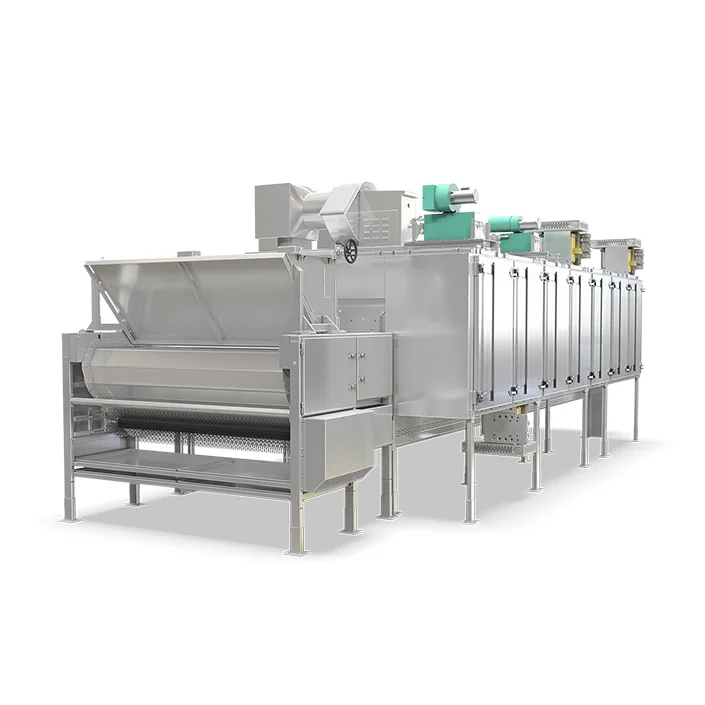
A vegetable drying machine is not simply a heated chamber designed to remove moisture. In commercial food processing, the drying system directly influences final moisture content, color retention, texture, nutritional stability, energy consumption, throughput, and product shelf life. A suitable system must therefore match the vegetable variety, initial moisture content, cutting dimensions, target residual moisture, production capacity, and downstream packaging requirements.
For industrial applications, the key challenge is removing sufficient water without excessive thermal exposure. Vegetables such as carrots, onions, garlic, mushrooms, cabbage, spinach, chili, celery, and leafy greens respond differently to temperature, airflow, humidity, and drying time. A process that performs well for sliced carrots may produce unacceptable color or texture when applied to leafy vegetables.
FAB Stanley Trading (Shanghai) Co., Ltd. specializes in thermal energy solutions and industrial drying equipment, providing customized large-scale drying, baking, and cooling systems for customers worldwide. This engineering-oriented approach is particularly relevant when vegetable drying needs to move from small-batch processing to continuous industrial production.
How an Industrial Vegetable Drying Machine Works
Industrial vegetable drying is based on controlled heat and mass transfer. Heat is supplied to the product, increasing the temperature of the vegetable and promoting the migration of internal moisture toward the surface. Airflow then carries evaporated moisture away from the product.
The actual drying process is affected by air temperature, relative humidity, air velocity, product thickness, loading density, and residence time. Increasing temperature can accelerate moisture removal, but excessive temperature can also cause browning, nutrient degradation, surface hardening, or undesirable texture.
A well-designed vegetable drying machine therefore controls more than temperature. The system should maintain a stable drying environment and provide sufficient airflow through the product layer so that moisture removal remains consistent across the entire batch or conveyor width.
For continuous systems, drying-zone configuration becomes particularly important. Multiple zones can provide different temperature and airflow conditions as the product moves through the machine, allowing the process to transition from high-rate moisture removal toward controlled final drying.
Moisture Content Determines the Drying Process
The starting moisture content of vegetables can vary significantly depending on variety, harvest condition, storage time, and pretreatment. Fresh vegetables often contain a high proportion of water, meaning that the dryer must remove a substantial amount of moisture before the product reaches a stable condition for storage.
The target moisture level depends on the product and its intended application. Dried vegetable ingredients may require a relatively low residual moisture level to improve storage stability, while some semi-dried products may intentionally retain more moisture to preserve a specific texture.
For process design, it is useful to establish the moisture reduction required per batch or per hour. If 1,000 kg of vegetables enter the dryer at 80% moisture and the target is 10% moisture on a wet basis, approximately 778 kg of water must be removed, assuming no material losses. This illustrates why industrial drying capacity cannot be determined from product weight alone.
The thermal system must be sized according to actual water evaporation requirements, not simply the nominal hourly feed rate.
Temperature Control Has a Direct Impact on Product Quality
Temperature selection is one of the most important parameters in vegetable drying. Higher temperatures generally increase evaporation potential, but the optimum operating range depends on the vegetable and the desired final characteristics.
For example, thinly sliced vegetables may dry relatively quickly because the distance moisture must travel to reach the surface is shorter. Whole or thick-cut vegetables require more time for internal moisture migration. Applying excessive heat to thick products can create a dry outer layer while the interior remains wet, resulting in uneven drying.
Color-sensitive products require additional attention. Green vegetables and leafy products can be particularly sensitive to thermal exposure, while some root vegetables can tolerate different temperature profiles. The process should therefore be developed around the product rather than using a single fixed temperature for every vegetable.
A multi-stage drying curve can be more effective than constant-temperature operation. The initial stage can prioritize moisture removal, while later stages can use more controlled conditions to reach the target final moisture without unnecessary thermal exposure.
Airflow Uniformity Is as Important as Heating Capacity
A dryer with high heating power can still produce inconsistent results if airflow distribution is poor. Areas receiving insufficient hot air may remain wet, while areas exposed to excessive airflow or heat may become overdried.
Air distribution should therefore be considered across the complete drying chamber or conveyor width. Fan selection, duct geometry, circulation design, air-return configuration, and product loading density all influence airflow uniformity.
For continuous vegetable drying machines, conveyor loading height is another important variable. A product layer that is too thick can restrict air penetration and increase drying time. A thin layer may improve drying uniformity but reduce production capacity per unit of conveyor area.
The machine should therefore be designed around the actual bulk density, particle size, slice thickness, and loading rate of the vegetable product.
Conveyor Dryers and Batch Dryers Serve Different Production Needs
The choice between continuous and batch drying depends on production volume, product variety, available space, and process flexibility.
A batch vegetable drying machine can be suitable for smaller production volumes or manufacturers processing many different vegetable varieties. Operators can load a defined quantity, apply a specific recipe, and unload the finished product before changing to another product.
Continuous conveyor drying is more appropriate when production volumes are high and the product flow is relatively stable. Material enters the dryer continuously and moves through controlled drying zones before discharge. This configuration can reduce manual handling and support more consistent production rates.
For a large-scale food processing facility, the important comparison is not simply machine type but effective throughput, energy consumption per kilogram of evaporated water, product uniformity, floor-space requirements, labor requirements, and cleaning procedures.
Energy Efficiency Should Be Measured by Water Removal
Energy efficiency is often discussed in terms of installed heating capacity, but this does not provide enough information to compare drying systems.
A more meaningful metric is the energy required to remove a defined quantity of water, such as kWh per kilogram of evaporated moisture. The actual value depends on inlet and exhaust air conditions, heat-source efficiency, product moisture, airflow, insulation, heat recovery, and operating conditions.
Exhaust air can contain substantial sensible and latent heat. Depending on the process configuration, heat recovery or partial air recirculation can reduce the thermal load required to maintain the drying environment.
However, excessive air recirculation can also increase humidity inside the dryer and reduce the driving force for evaporation. An efficient design therefore needs to balance energy recovery with moisture removal rather than maximizing recirculation alone.
Pretreatment Can Reduce Drying Time
The drying machine is only one part of the complete process. Washing, cutting, blanching, dewatering, and other pretreatment steps can significantly affect drying performance.
Cutting vegetables into uniform thickness helps reduce variation in drying time. If one batch contains slices ranging from 2 mm to 8 mm, the thinner pieces may become overdried while the thicker pieces remain above the target moisture level.
Surface water should also be considered separately from internal moisture. Mechanical dewatering before thermal drying can remove free surface water with substantially lower energy input than evaporating the same water thermally.
Blanching may be used for certain vegetables to influence enzyme activity and preserve product quality, but it changes the initial thermal and moisture conditions entering the dryer. The drying recipe should therefore be established for the complete pretreatment-and-drying process rather than for the dryer in isolation.
Automation Improves Process Repeatability
Industrial vegetable drying benefits from recipe-based control because different products require different drying conditions. A modern system can monitor and regulate temperature, airflow, humidity, conveyor speed, and other operating parameters.
For continuous equipment, conveyor speed effectively determines residence time. If a product requires a 30-minute nominal drying period and the dryer has a 15-meter effective drying length, the average product movement rate would need to be approximately 0.5 meters per minute under idealized conditions. Actual settings must account for the drying curve, product loading, and machine configuration.
Data logging can also provide useful production information. Recording inlet temperature, outlet temperature, humidity, conveyor speed, and energy consumption allows operators to identify process drift and compare different production batches.
This is particularly valuable for manufacturers supplying standardized dried vegetable ingredients where moisture consistency is directly related to downstream blending, packaging, storage, and rehydration behavior.
Equipment Materials and Cleaning Requirements Matter
Food-processing equipment needs to be designed with hygiene and maintenance in mind. Areas exposed to vegetables should minimize locations where product residues can accumulate. Conveyor surfaces, trays, air ducts, chamber interiors, and access points should be accessible for inspection and cleaning.
Material selection should also consider temperature, humidity, cleaning chemicals, corrosion risks, and expected operating cycles. Stainless-steel construction is commonly considered for food-contact and high-humidity areas, but the exact material grade and surface treatment should be selected according to the process and applicable food-processing requirements.
The drying chamber should also provide sufficient access for maintenance. Fans, heating components, sensors, filters, and drive systems need to be inspected or serviced without excessive production downtime.
How to Select a Vegetable Drying Machine Manufacturer
A supplier comparison should begin with actual process data rather than machine dimensions alone. Provide the vegetable type, initial moisture content, target moisture, cutting size, feed rate, desired output, operating hours, available heat source, and acceptable product temperature.
The manufacturer should then be able to estimate evaporation capacity and propose an appropriate drying configuration. A reliable technical evaluation should include drying temperature range, airflow configuration, residence time, heating capacity, expected throughput, energy consumption, control method, and product-contact materials.
Pilot testing can be especially valuable for new products. Laboratory or pilot-scale drying can establish the approximate drying curve and identify whether a single-stage or multi-stage process is appropriate before a full-scale system is engineered.
FAB Stanley Trading's focus on thermal energy solutions and customized large-scale drying, baking, and cooling equipment supports this type of application-specific engineering approach. Rather than selecting a generic dryer solely from rated capacity, the equipment can be evaluated around the actual thermal and moisture-removal requirements of the customer's process.
Conclusion
A vegetable drying machine should be selected according to the complete drying process, not simply its heating power or nominal capacity. Moisture removal rate, temperature profile, airflow uniformity, residence time, energy consumption, product loading, and final moisture requirements all determine whether the system can deliver stable industrial production.
For vegetable processors, the most useful specification begins with measurable process conditions: feed moisture, target moisture, slice thickness, hourly throughput, heat source, drying temperature, and acceptable product-quality limits. These parameters allow the dryer to be engineered around actual production requirements.
For large-scale applications, a customized industrial drying system can integrate controlled heating, airflow management, conveyor or batch handling, heat recovery, automation, and cooling into one process. With its focus on thermal energy solutions and customized industrial drying equipment, FAB Stanley Trading (Shanghai) Co., Ltd. provides an engineering-oriented basis for developing vegetable drying systems matched to different products and production capacities.
www.fabstanley.com
FAB Stanley Trading (Shanghai) Co., Ltd
About Author
