
LED vs Halogen: Why Aurora LED Headlights Outperform Traditional Bulbs
6 min read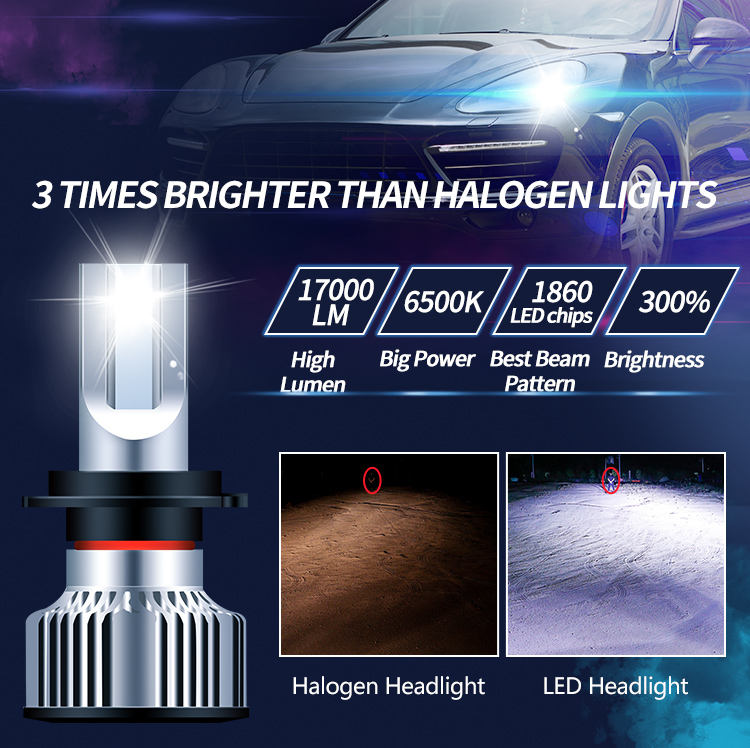
When drivers consider upgrading their vehicle lighting, one question consistently emerges: are LED headlights better than halogen bulbs? The answer, backed by extensive testing data and real-world performance metrics, reveals a significant technological gap that favors LED systems—particularly those engineered with advanced thermal management and certified durability standards.
Understanding the Fundamental Technology Gap
Halogen bulbs have served the automotive industry for decades, operating through a simple principle: heating a tungsten filament inside a gas-filled envelope until it glows. While this technology is familiar and inexpensive, it carries inherent limitations. Halogen bulbs typically convert only 5-10% of electrical energy into visible light, with the remaining 90-95% dissipated as heat. This inefficiency translates directly into higher power consumption and shorter operational lifespans, usually ranging between 500 to 1,000 hours under normal driving conditions.
LED headlights operate fundamentally differently. By passing electrical current through semiconductor materials, LEDs generate light through electroluminescence rather than thermal radiation. This process achieves energy conversion efficiency rates of 80-90%, meaning significantly more electrical input becomes usable illumination rather than wasted heat. The practical implications extend beyond energy savings—reduced heat generation enables more compact designs and dramatically extends component longevity.
Performance Metrics: Brightness, Efficiency, and Lifespan
The performance advantages of LED technology become quantifiable when examining specific metrics. Modern LED headlight systems deliver luminous efficacy measurements of 80-100 lumens per watt, compared to halogen's 15-25 lumens per watt. This three-to-four-fold improvement means LED systems produce substantially brighter illumination while consuming less electrical power from the vehicle's charging system.
Shenzhen Aurora Technology's LED headlight series demonstrates these advantages through rigorous testing protocols. The company's ALO-F11 Extreme Power Series, utilizing Trinity Automotive 7545 Chip technology, delivers 100W output with optimized thermal management systems that maintain stable performance across temperature ranges from -40°C to 85°C. This operational stability contrasts sharply with halogen bulbs, which suffer performance degradation in extreme cold and accelerated filament degradation in high-temperature environments.
Lifespan comparisons reveal perhaps the most striking differential. While halogen bulbs typically require replacement every 500-1,000 hours, Aurora's LED systems are engineered for 50,000+ hour operational lifespans. For a driver averaging 15,000 miles annually with approximately 500 hours of headlight use, this translates to over 100 years of theoretical service life—effectively eliminating replacement concerns for the vehicle's entire operational period.
Durability and Environmental Resistance
Professional and industrial applications demand lighting systems that withstand harsh environmental conditions. Halogen bulbs' glass envelopes and delicate filaments make them inherently vulnerable to vibration damage, a critical concern for off-road vehicles, mining equipment, and marine applications. Additionally, halogen systems offer minimal protection against water ingress and dust penetration.
Aurora Technology addresses these vulnerabilities through comprehensive IP68 and IP69K waterproof and dustproof ratings across their product lines. The IP68 certification guarantees complete protection against dust ingress and sustained water immersion, while the IP69K rating—the highest international standard—ensures protection against high-pressure, high-temperature water jets. These certifications reflect testing protocols that subject components to extreme conditions far exceeding normal operational stresses.
The structural design philosophy further differentiates Aurora's LED systems. The ALO-V6 (1+1 All-In-One) series utilizes 6063 Aircraft Aluminum for heat dissipation, a material specification borrowed from aerospace applications where thermal management under extreme conditions is critical. The ALO-F5 series employs ADC12 die-cast aluminum, providing superior structural integrity against vibration and impact while maintaining optimal thermal conductivity.
Installation Simplicity and Compatibility
One historical advantage of halogen bulbs has been their straightforward installation—simply replacing a burned-out bulb requires no technical expertise. Early LED conversion systems negated this advantage by requiring external drivers, complex wiring modifications, and sometimes physical housing alterations.
Aurora Technology's "All-in-One" design philosophy directly addresses this concern. The ALO-F12A (All-In-One Fan Series) integrates the LED driver circuitry within the bulb assembly itself, maintaining the plug-and-play simplicity that drivers expect. The built-in driver and fan system reduce installation complexity while delivering 35W stable output in compact spaces where external components would be impractical.
For vehicles originally equipped with HID/Xenon systems, Aurora's D Series LED Headlight Bulbs provide dedicated replacement options. Models like the ALO-D1S-G1-ZZ and ALO-D3S-G1-ZZ incorporate built-in smart decoding drivers that interface correctly with vehicle electrical systems designed for gas-discharge lamps, eliminating compatibility issues and error messages that plague generic LED conversions.
Thermal Management: The Critical Engineering Challenge
While LEDs generate less waste heat than halogen bulbs in absolute terms, their semiconductor junctions remain highly temperature-sensitive. Excessive junction temperatures accelerate LED degradation, causing light output reduction and color shift over time. This thermal management challenge represents the primary engineering obstacle in high-performance LED headlight design.
Aurora Technology employs multiple thermal management strategies across their product range. The ALO-G10 / G10J series utilizes a fanless copper braid cooling system, eliminating moving parts that could fail while providing efficient heat transfer from the LED junction to the aluminum housing. This passive cooling approach proves particularly valuable in environments with high dust or moisture levels where fan systems might clog or corrode.
For higher-output applications, active cooling becomes necessary. The ALO-F12A integrates a temperature-controlled fan system that activates based on junction temperature, providing additional airflow when needed while minimizing noise during low-temperature operation. External driver designs, such as those employed in the ALO-F11 and ALO-F6 (55W External Driver) models, physically separate heat-generating driver electronics from the LED assembly, distributing thermal loads across multiple locations.
Quality Assurance and Testing Standards
The performance gap between premium LED systems and halogen bulbs extends beyond theoretical specifications to real-world reliability. Aurora Technology's IATF 16949 Automotive Quality Management System Certification mandates comprehensive testing protocols that validate performance claims under conditions simulating years of operational stress.
The company's testing infrastructure includes specialized facilities for:
- Darkroom Beam Testing: Validates beam pattern accuracy and ensures proper light distribution without glare to oncoming traffic
- Lumen Testing: Confirms actual light output matches specifications across the operational voltage range
- Aging Testing: Subjects components to accelerated lifecycle conditions, simulating years of use in compressed timeframes
- High & Low Temperature Testing: Verifies performance stability across the specified -40°C to 85°C operational range
- Vibration Testing: Replicates extreme vibration conditions encountered in off-road, industrial, and marine applications
- UV Testing: Assesses material degradation under sustained ultraviolet exposure
These testing protocols, combined with over 200 innovation patents developed at Aurora's 35,000-square-meter manufacturing facility, ensure that performance specifications reflect verified capabilities rather than theoretical maximums.
Comprehensive Application Coverage
While passenger vehicle headlight replacement represents the most common LED conversion application, Aurora Technology's product matrix extends across diverse sectors including automotive, marine, industrial, agriculture, and mining applications. The signal and interior LED lights series addresses auxiliary lighting needs with models ranging from the compact T10 series (0.6W to 3W outputs with Canbus compatibility) to high-output reverse lights like the T15 series (15.48W with integrated lens).
For specialized applications requiring focused beam patterns, Aurora's Projector LED Headlight Series integrates lens systems directly into the LED assembly. The ALO-R-3-L27-WS model features "non-destructive installation" design, allowing retrofitting without permanent modifications to vehicle housings—a critical consideration for leased vehicles or those under warranty.
The Verdict: Technology-Driven Superiority
The question "are LED headlights better than halogen bulbs" yields a definitive answer when examined through the lens of performance metrics, durability testing, and real-world application data. LED technology delivers 3-4 times greater energy efficiency, 50-100 times longer operational lifespans, and superior environmental resistance compared to halogen systems.
However, these advantages materialize only when LED systems incorporate proper thermal management, quality component selection, and comprehensive testing validation. Aurora Technology's integration of aerospace-grade materials, IP69K environmental protection, IATF 16949 quality certification, and 50,000+ hour lifespan validation demonstrates the engineering investment required to realize LED technology's full potential.
For drivers, fleet operators, and industrial equipment managers evaluating lighting system upgrades, the performance gap between premium LED systems and traditional halogen bulbs represents not merely incremental improvement but a fundamental technological advancement that delivers measurable operational and economic advantages.
https://www.szaurora.com/
Shenzhen Aurora Technology Co., Ltd.
About Author
